Breath
You are where you need to be.
Just breathe.
Pranayama – Breath Control
Prana – life energy, breath, vehicle of consciousness and awareness
Ayama – discipline, control, stretch, extend, expand, regulate, prolong

Imagine yourself with renewed vigour, searing power, bursting with vitality, an energised nervous system, a soaring spirit and a de-stressed and refreshed mind… “So, where can I get me some of that?” you ask. Yes, it would make a pretty lucrative packaged product, huh! Luckily its all around us all the time and it’s free – it’s just a matter of ayama, harnessing it correctly.
Humans have been known to survive for months without water and weeks without food yet die within minutes when deprived of oxygen. And yet, theres a marked difference between breathing oxygen to stay alive and breathing to consciously harness and distribute energy.
Pranayama is not just breathing – you’re generating vital energy: fusing two antagonistic elements, fire and water, together along a third, air, to be distributed as a fourth, ether, within a fifth, earth (your body). It’s pretty complex.
Day or night, most of our breathing is sub-conscious and is regulated by excess Carbon Dioxide in the blood, not by a need for Oxygen. As we breathe subconsciously, only to reduce Carbon Dioxide – we tend to breathe shallow, just enough to make CO2 levels tolerable, using less than a third of the capacity of our lungs in this process.
Inadequate Oxygen supply, coupled with day-to-day stress results in numerous bodily complications. Heart diseases, sleep disorders, stomach ulcers and fatigue are some of the common physical effects of Oxygen starvation, whereas anger, lack of concentration and focus are among mental manifestations.
Prana, Chi, Ki, the Holy Spirit, whatever you may call it is the hidden potential energy in all beings, released to the fullest extent as a response to any threat to ones survival. It Generates (inhale), Organises (retain), Destroys (exhale) – an essential and mysterious feature of every moment of our lives.
When prana flows abundantly through our beings and enough oxygen courses through our arteries, we become aware of a special glow to our skin and eyes, a spring to our step and the pulse of energy in every cell, vibrating vitality through every thought, word and deed. On the other hand, an impeded or deficient flow of prana and oxygen is marked by constant fatigue, dull skin and eyes and loss of enthusiasm.
Breathing exercises are designed to increase the flow of prana in our body and to unleash dormant prana and release toxins.
“As wind drives away smoke and impurities from the atmosphere, pranayama is a divine fire which cleanses the organs, senses, mind, intellect and ego.”
~ BKS Iyengar, Hatha Yoga master
The Subtlety of Pranayama
Pranayama starts with observing the movement of normal breathing and letting it become quiet and soft in such a way that there is no load on the cells of the brain. To do this, learn to release the diaphragm. The diaphragm is the connection between your mind and body – when you’re tense or stressed, your diaphragm tightens.
Let your breathing be thoughtful, conscious, un-greedy and natural. Be aware of the role of the thorax, diaphragm, ribs, intercostal muscles, abdomen and lungs. Make full use of this system without straining the nervous system; your breathing cycle should not be jerky or disjointed as this is likened to a fluctuating current in a circuit board – not good. Try to keep the movement fluid, circular and consistent.
A regulated breath –> a regulated mind.
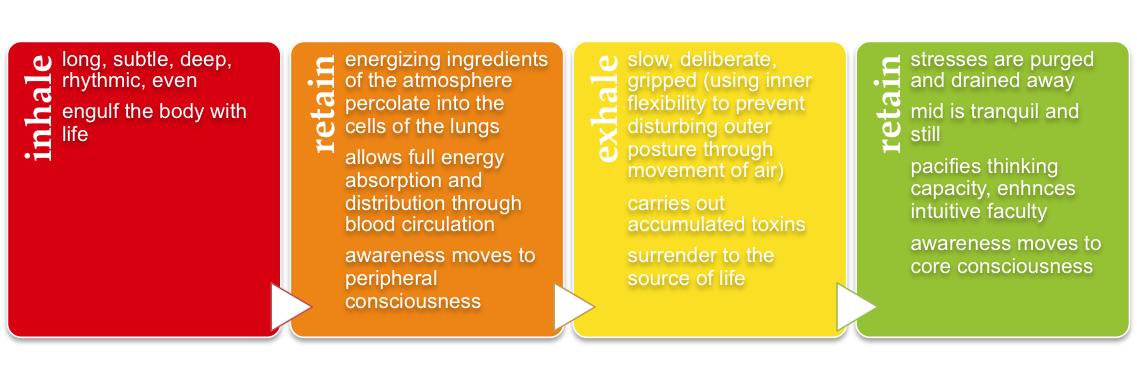
The beauty of pranayama is that you can’t focus on the inner movement of the breath and use outer senses simultaneously. This is the beginning of withdrawal from your senses – this is what brings peacefulness.
Remember, do not force anything. That defeats the purpose. Have enough humility to maintain a steady practice and what you are chasing will come to you. The moment your brain tenses, your inner ear hardens, your eyes stiffen or become heavy, you are forcing yourself beyond capacity and overloading your nervous system. Be both bold and cautious. Your breath and will should move simultaneously. If your will moves first, you’re using force.
“By withdrawing the mind from the senses of perception and organs of action, retention of breath brings consciousness to rest on the lap of the soul.”
~ BKS Iyengar, Hatha Yoga master
How it All Comes Together
Pranayama is 1 of 8 branches of yoga (see Patanjali’s 8 Limbs of Yoga) that deals with conscious control of breath. Pranayama Yoga helps rejuvenate our body and mind by increasing Oxygen supply and removing Carbon Dioxide to and from the blood stream and the whole body.
If you compare your body to a circuit board that sends energy (prana) coursing to the extremities of your body, it is easy to understand that increasing the current running throughout his circuitry (through pranayama) requires stronger, more stable and durable wiring and conducting to prevent blowing the circuit. This is a really good example of the interrelatedness of all the basic functions of the body and how the strength of one is the strength of another.
Therefore, your body needs to be primed properly to handle this increase in current. This is done through yoga and other forms of body strengthening. You also need to build sufficient fortitude in body and mind to be able to control yourself sensibly – not gorging yourself one day and fasting the next and ricocheting between behavioural, emotional and mental extremes – to lay a solid foundation for the other basics to be built on.
Another way of looking at the interconnectedness of exercise and pranayama is:
- exercise gives you poise, confidence and radiance
- pranayama allows you to inwardly invest these gains
What Controls What – How It Is:

We feel hot. This aggravates us. We breath faster and more heavily. Our nerves become jittery and we become more edgy and snappy.
What Controls What – How It Should Be:

We need to consciously apply our nervous system to regulate our breathing. Regulated breathing calms the mind. A calm mind has better control of your senses.
Click here for Pranayama Exercises and Techniques
Sources:
www.chopra.com, Deepak Chopra
Light on Life, BKS Iyengar, 2005 Swami Ramdev